/Overview

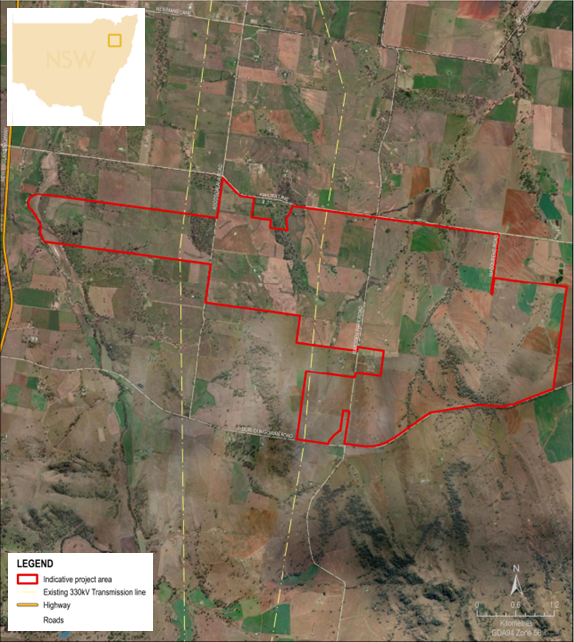
Venn Energy is developing the Lambruk Solar Farm in Loomberah, near Tamworth in New South Wales. The proposed development will include a solar farm and a Battery Energy Storage System (BESS), covering 950 hectares.

If approved, the Lambruk Solar Farm is expected to be operational starting in 2029, with a 30-year project life. Once operational, Lambruk will generate enough clean energy to:

  • Power up to 180,000 NSW homes
  • Avoid the generation of approximately 600,000 tonnes per year of carbon dioxide (CO2)
  • Reduce emissions equivalent to that produced by approximately 159,429 vehicles each year
  • Reduce greenhouse gas emissions from the environment – equivalent to the burning of approximately 303,030 tonnes of coal per year
  • The BESS would maximise electricity exported to the grid and provide reliable energy by stabilising the grid and shifting the supply of electricity from times of high supply and low demand to times of low supply and high demand

*The average annual electricity consumption per household in New South Wales is 5.662 MWh, according to the Residential Energy Consumption Benchmarks – Final Report for the Australian Energy Regulator, published on 9 December 2020.

/Project Development TIMELINE

Understand the timeline and steps involved in developing the Lambruk Solar Farm.

STAGE 1.
Planning (2 years)
Site Identification
  • Site visits
  • Host landowner agreements
Preliminary Studies
  • Feasibility and initial assessments
  • Early development layout
  • Scoping report
CURRENT STAGE
Specialist studies
  • Aboriginal cultural heritage
  • Biodiversity
  • Glint and glare
  • Historic heritage
  • Hydrology
  • Landscape and visual
  • Noise
  • Transport
  • Social impact assessment
  • Soils and Agriculture
  • Other environmental assessments
STAGE 2.
Approvals (1 years)
Planning and environmental approvals
  • Community consultation on, and exhibition of Environmental Impact Statement Submission to Government planning authorities
Management plans and consents
  • Emergency and bushfire
  • Traffic & construction
  • Environment and waterways
STAGE 3.
Construction (2 years)
Procurement
  • Detailed design
  • Geotechnical studies
  • Technology and contractor selection
  • Grid connection process
Construction
  • Road upgrades
  • Civil and electrical
  • Installation of project infrastructure (eg: solar panels etc)
  • Commissioning
STAGE 4.
Operation (30 years)
Operation
  • Maintenance
  • Servicing
  • Environmental compliance (e.g. noise monitoring)

*This outlines the typical steps undertaken by the developer but is not exhaustive and
does not reflect all regulatory processes, government decisions, or the precise timing and duration of each stage.

/WHAT THE LAMBRUK SOLAR FARM MEANS FOR NSW

power produced
0 MW
homes powered
0
carbon dioxide saved per year
0 t

/Why has this location been chosen?

The greatest challenge for selecting where to develop new solar farms is identifying areas within the electricity grid with available capacity to connect.

Once an area of the grid has been identified with capacity, planning experts assess the viability of the area based on various opportunities and constraints such as ecology, transport arrangements, landscape value, cultural heritage significance, agricultural land value, hazards, and amenity impacts. 

Venn Energy has identified the proposed site as an ideal place for a solar farm for the following reasons: 

  • The site is in an area of excellent solar exposure. 
  • The site has an existing transmission line, allowing for easy connectivity to the grid. 
  • The site has already been largely cleared of native vegetation and has been heavily disturbed by previous agricultural activities, including cropping. 
  • The proposed layout allows for the minimal disturbance of native vegetation and wildlife.