Find out more about the project and view our frequently asked questions.
Site selection
Q4 2024
Scoping report
Q2 2025
Environmental impact statement
2025-2026
Development approval
Early 2027
Grid connection agreement
2027
Construction
Late 2027
Operation
2029-2059
Decommissioning
2059/2060
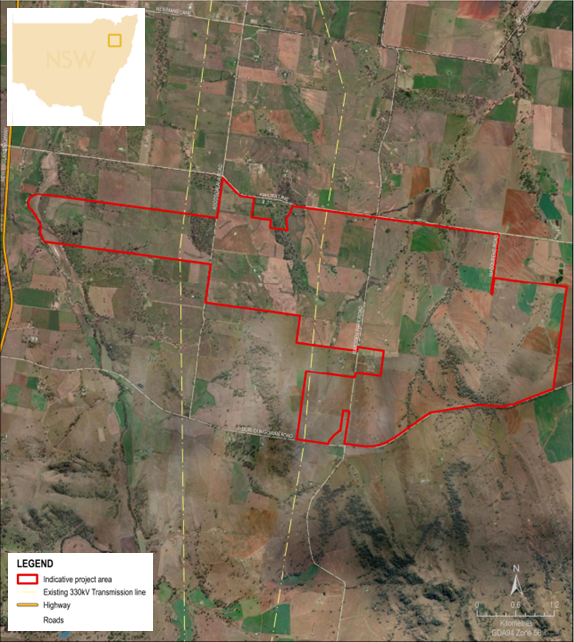
Venn Energy is developing the Lambruk Solar Farm (the Project) at Loomberah, 15km southeast of Tamworth, in North West NSW. The solar facility would have a targeted electricity generating capacity of up to 500 MW (DC) and 300 MW (AC). The final number of photovoltaic (PV) panels would be dependent on detailed design, availability, and commercial considerations at the time of construction. The panels would be mounted on a single axis tracker that changes orientation throughout the day to follow the sun and maximise energy captured.
The proposed site is located between Kia Ora Lane and Duri-Dungowan Road. Once operational the Project has the potential to generate enough clean renewable energy to:
The Project is still in the planning stage. A scoping report was submitted to the NSW Department of Planning, Housing and Infrastructure (DPHI) in February 2024. This documents preliminary feedback received through community consultation, as well as preliminary results of specialist biodiversity, noise, social and visual studies. The scoping report is available here.
The comprehensive Environmental Impact Statement (EIS) has now been submitted (December 2025). The EIS will be publicly exhibited and the community will have the opportunity to review it and make submissions during the assessment process.
The greatest challenge for selecting where to develop new solar farms is identifying areas within the electricity grid with available capacity to connect. Once an area of the grid has been identified with capacity, planning experts assess the viability of the area based on various opportunities and constraints such as ecology, transport arrangements, landscape value, cultural heritage significance, agricultural land value, hazards, amenity impacts, etc.
Venn Energy has chosen the proposed site as an ideal place for a solar farm for the following reasons:
The project would have several potential direct and indirect economic benefits for the local community. These benefits include:
To ensure national power supply, the Australian grid is evolving at speed to incorporate more resilient power generation from a range of sustainable and cost-effective resources, including solar, wind and hydro generation with energy storage. This diversity in energy supply is critical to secure low-cost energy for domestic and industrial energy consumers, reducing the environmental and financial costs and risks associated with fossil fuel.
The Secretary’s Environmental Assessment Requirements (SEARs) for the project were issued in March 2024. The SEARs are available on the NSW Major Projects Planning Portal.
The Project is required to assess the likely impacts of the development on the environment, focusing on the specific issues identified in the SEARs. Other state significant solar developments would have similar assessment requirements.
The following assessments have been undertaken or are in the process of being completed:
The NSW Government requires cumulative impacts of state significant developments to be assessed as part of the environmental impact statement (EIS). These requirements are described in the Cumulative Impact Assessment Guideline (DPIE, 2021) and specified in the Secretary’s Environmental Assessment Requirements (SEARs), which are the minimum requirements for the EIS to be accepted by the Department of Planning, Housing and Infrastructure.
Yes, an Aboriginal cultural heritage assessment and associated Aboriginal community consultation has been undertaken during preparation of the EIS. Prior to commencing construction, a cultural heritage management plan would also be prepared in consultation with Aboriginal stakeholders and Heritage NSW and approved by the Department of Planning, Housing and Infrastructure. The cultural heritage management plan will assess the potential impact of the project on any sites of cultural significance and provide a detailed management plan should any cultural artefacts be identified during construction. Archaeological and historic artefacts identified during surveys have been avoided through the project design.
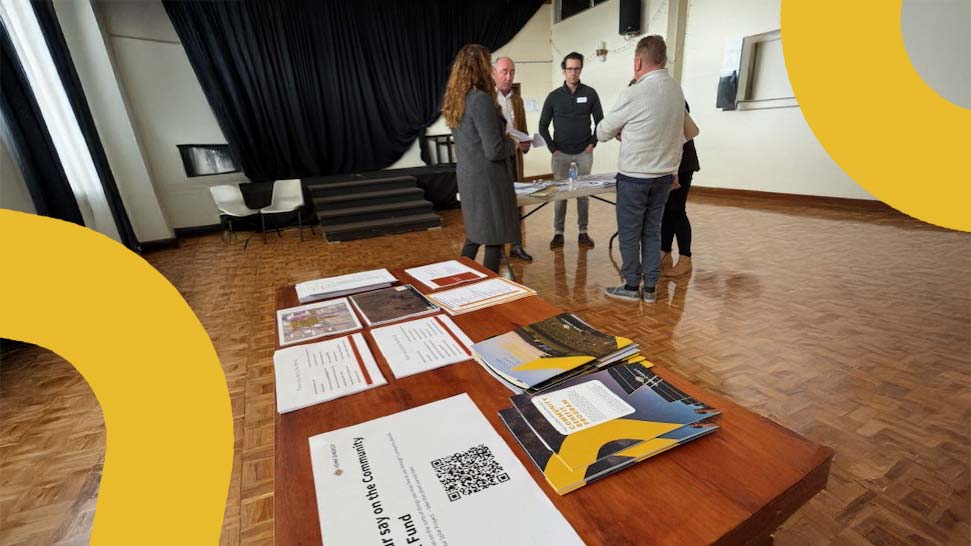
Venn Energy has been engaging with the Project neighbours and the wider community about the Project since late 2022. This has included community drop-in sessions, in-person and virtual meetings with individuals, small groups and community, presentations and briefings with key stakeholders, calls, emails and a monthly newsletter.
We have been reaching out to those people closest to the Project to listen to their concerns and discuss possible and likely impacts. We have been working closely with our Project designers to avoid, mitigate or manage impacts and will continue to do so as the Project design is refined.
We believe the local community should share in the benefits of the Project and have committed to establishing a neighbour and community benefit sharing program. As part of this program, it is intended that project neighbours and the wider community will be involved to ensure funds are appropriately administered and we will continue to engage with the wider Loomberah and Timbumburi community.
Yes, it is proposed that panel arrays will be spaced adequately apart, providing space for the land to be used for agricultural purposes, such as sheep grazing. Livestock grazing has become a widespread practice in conjunction with renewable energy developments. This practice is known as agri-photovoltaics. Not only do livestock thrive but they also assist in maintenance of the project site, keeping vegetation low and assisting with weed management.
As required on all renewable energy developments, post-development water flows must be equivalent to predevelopment flows in terms of both water quality, path and volume. Extensive hydrology models will be developed for the site to inform the design process to ensure these objectives are achieved after construction.
The Project will mitigate the risk of fire, pollution, explosion and other hazards by:
Even though there is no direct evidence linking the presence of a Solar Farm and/or BESS with devaluation of properties, it is noted that this perceived potential impact on property values in the local area can impact resident’s mental and emotional health. The Project will continue to collaborate closely with landholders to support them how they are best able to. The Project design has minimised visual and amenity impacts (setbacks, screening and landscape treatments), provide clear information to real estate agents and prospective buyers about the Project and its approvals where requested.
The NSW Government has several guidelines and policies that must be addressed when assessing noise impacts of renewable energy projects. Detailed noise modelling will be undertaken, with the results to be included in a noise impact assessment. Modelling is undertaken for noise sources during day-time and night-time periods, noting that construction would be restricted to standard construction hours. Noise modelling will predict the noise levels from construction, operation and traffic of the project and compare it with the allowable limits set by the NSW Government.
The visual impact assessment for the Project will be undertaken in accordance with the recently updated NSW Large Scale Solar Guideline Technical Supplement for Landscape Character and Visual Impact Assessment (DPHI, 2024).The new technical supplement aims to strengthen the landscape and visual impact assessment process to ensure consistent decision-making in the assessment process.
The landscape character impact assessment assesses the potential impact on an area’s cumulative built, natural and cultural character or sense of place, where a visual impact assessment assesses the potential impact on views.
The technical supplement recognises that visual amenity should be afforded some protections. However, it also recognises the fundamental principle that landowners have no proprietary right to or ownership of a view, and a visible solar array or ancillary infrastructure does not necessarily constitute a visual impact.
Changes to the rural and natural landscapes will be necessary to facilitate a transition to renewable energy and to support the development of the solar energy industry. The new technical supplement aims to achieve balanced outcomes that avoid and manage significant landscape and visual impacts while supporting this change.
The Project has demonstrated the minimisation of clearing through refined Project design. A BDAR (OzArk 2025b) and the required targeted flora and fauna surveys have been completed. A Biodiversity Management Plan (BMP) will be prepared (avoidance/minimisation, pre-clearing/clearing protocols, salvage/translocation where feasible, offsets/onsite restoration, revegetation monitoring, weed/feral animal control, reporting).
We will only select BESS and PV components that meet industry environmental and safety standards. The BESS will incorporate a BMS and fire mitigation technologies. A Soil and Water Management Plan (SWMP) will be developed and implemented to address temporary and site-specific risks to sediment and erosion risk during construction and describe soil and water management measures to be implemented. A Construction Environemntal Management Plan (CEMP) will be developed to identify site specific controls and procedures to minimise the potential for hydrocarbons and other contaminants being discharged into the environment. The CEMP will consider at a minimum, protocols for the storage of hydrocarbons and other liquid chemicals, re-fuelling of construction vehicles and equipment, maintaining emergency spill kits and relevant emergency spill response procedures, and transportation and disposal of any hydrocarbons captured during Project construction and operation of the substations and switchyards at a suitable off-site licenced facility.
The Project identifies Project water demand, preferred water sources (purchased supply, on site storages, recycled water) and contingency arrangements. The plan includes triggers to reduce or cease non-essential water use during drought, a commitment that local town supply has priority, and measures to minimise consumptive use (water efficient fittings, recycled water for construction uses).
We will design the site so runoff and flood risk are managed and do not make things worse offsite. Measures include engineered drainage to direct and treat surface water, erosion and sediment controls during construction, and detention/retention basins to keep post‑development flows consistent with pre‑development conditions. Where possible we’ll use permeable surfaces, and key infrastructure will be built to be flood‑resilient (for example, raised platforms and protected electrical equipment).
The Project has sought to minimise permanent loss of productive land, panel layout optimisation, and selecting parts of the holding with lower agronomic value where practicable. Options to enable compatible land uses (e.g., sheep grazing under and between arrays) will be investigated and implemented where safe and appropriate. The Decommissioning Rehabilitation Plan (DRP) will require reinstatement of agricultural capability at the end of life where appropriate.
The Project is covered by public liability insurance and that comprehensive fire mitigation measures would be in place, including on-site water tanks, BESS fire suppression systems, and detailed emergency response plans while continuing to coordinate with local emergency services as required.
Access will be via the New England Highway, then Duri‑Dungowan Road, Ascot‑Calala Road and Marsden Park Road. An agreement with Tamworth Regional Council will guide construction standards and maintenance. A detailed traffic management plan (TMP) will be prepared before construction, and the Project and its construction partner will follow requirements and consider road users, stakeholders and the community.
We will manage construction traffic to minimise disruption to farming and harvest. Measures include enforcing a Construction Traffic Management Plan, giving advance notice of planned works to affected people, and consulting with government transport agencies and Tamworth Regional Council. Work hours will be limited to weekdays 7am–6pm and Saturdays 8am–1pm (no routine work on Sundays or public holidays); any work outside these times will require permits. We’ll use road signage and reduced speed limits where needed, and keep stakeholders and road users informed with timely updates.
To reduce the potential visual impact of the Project, the following mitigation measures have been recommended in the LCVIA (Moir 2025) will be implemented:
The potential for heat island impacts has been considered within studies showing that solar farm installations may exhibit an increase of between 1 – 5°C in the local micro-climate, depending on existing climatic conditions and groundcover vegetation (Baron-Gafford et al. 2016; Fthenakis & Yu 2013). The vegetation screening proposed for the Project will be higher than the panels (in time) and screen the warm panels from radiating to adjacent agricultural areas. Any temperature increase within the PV array will be marginal and recommended a 30 m setback from any neighbouring property boundary.
If the project is approved, and final investment decision received, construction is proposed to commence in late 2026.
Construction would take approximately 24 months.
Any works will occur within normal working hours (weekdays from 7am to 6pm and Saturday 8am to 1pm, with no work on Sundays or public holidays).
During construction, the following measures will be in place to minimise noise and vibration:
During construction, the following measures will be ensured to minimise dust generation:
We will manage dust during construction through a Construction Environmental Management Plan (CEMP). This will minimise exposed soil and stabilise or revegetate disturbed areas as work progresses, use water carts or approved dust suppressants on haul roads and work zones, and enforce lower vehicle speeds on site and nearby unsealed roads to reduce dust generation. We will also coordinate with Tamworth Regional Council on any required local road upgrades and work with neighbouring landholders to plan and limit dust‑sensitive activities, providing advance notice where needed.
The Noise Impact Aassessment (MAC 2025) adopts a conservative approach for both construction and operation of the Project. Operational noise level predictions at all relevant noise sensitive receivers have been conducted and will achieve full compliance with the relevant criteria. The Project will implement a Construction Noise and Vibration Management Plan (CNVMP) and ensure working hours, except where for practical reasons the construction activity is unavoidable (and thus communicated and approved by TRC), are between: 7am to 6.00pm, Monday to Friday, and 8am to 1pm, Saturday. An out-of-hours works permit will be required outside of these times.
The Project includes pre-clearing surveys, quarantine and hygiene procedures for machinery and materials, targeted weed removal and revegetation with local provenance species, regular monitoring and rapid response for new infestations, feral animal control where appropriate, and training for contractors on weed identification and control. The Project will coordinate with local landholders and biosecurity authorities to align control measures.
Peak workforce during construction is estimated at approximately 350 workers. Accommodation will not be provided onsite.
There will be approximately 10–15 staff will be onsite during operations during daytime working hours.
The Noise Impact Assessment (MAC 2025) adopts a conservative approach for both construction and operation of the Project. Operational noise level predictions at all relevant noise sensitive receivers have been conducted and will achieve full compliance with the relevant criteria. The Project will implement a Construction Noise and Vibration Management Plan (CNVMP) and ensure working hours, except where for practical reasons the construction activity is unavoidable (and thus communicated and approved by TRC), are between: 7am to 6.00pm, Monday to Friday, and 8am to 1pm, Saturday. An out-of-hours works permit will be required outside of these times.
A Decomissioning and Rehabilitation Plan (DRP) will be developed before operations commence and updated as required. The DRP will specify decommissioning scope, timeframes, removal standards for above and below ground infrastructure, reinstatement of topography and soils, revegetation and monitoring, materials handling, and waste/disposal/recycling pathways. The Project will commit to restoring the Project Site to an agreed standard with landowner input and to meet regulatory obligations. The DRP will identify responsibilities, financial assurances or security mechanisms consistent with regulatory requirements, and measures that will apply in the event of ownership change to ensure obligations are met.